As we know that, accounting involves a process of identifying and. analyzing the business transactions, recording them, classifying and summarising their effects, and finally communicating it to the interested users of accounting information. Now, we will discuss the details of each step involved in the accounting process. The first step involves identifying the transactions to be recorded and preparing the source documents which are in turn recorded in the basic book of original entry called journal and are then posted to individual accounts in the principal book called ledger.
Business Transactions and Source Document
Business Transactions: Business transactions are exchanges of economic consideration between parties and have the two-fold effect that one recorded in at least two accounts. For example, purchase of furniture for cash.
It involves the reciprocal exchange of two things:
- payment of cash,
- delivery of furniture.
Source Document: Each business transaction should be supported by documentary evidence such as cash memos, cash receipts, invoices or bills, debit and credit notes, pay-in-slip, cheque,s, etc. These business documents are called source documents.
Vouchers: On the basis of source document entries are, first of all, recorded on vouchers, and then on the basis of vouchers recording is made in the Journal or books of original entry. A separate voucher is prepared for each transaction and it specifies the accounts to be debited and credited. Vouchers are prepared by an accountant and each voucher is countersigned by an authorized person of the firm.
Types of Accounting Vouchers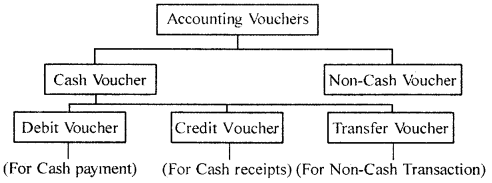
Note: Transfer Voucher is also called Transaction Voucher. Specimen of Transaction Voucher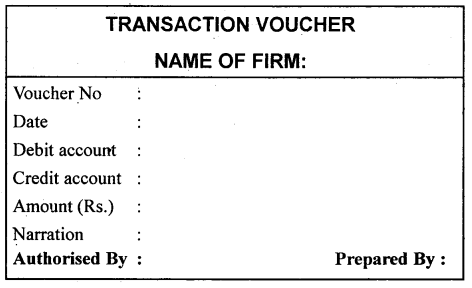
Specimen of Debit Voucher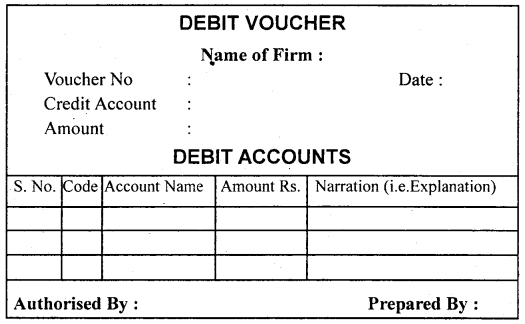
Specimen of Credit Voucher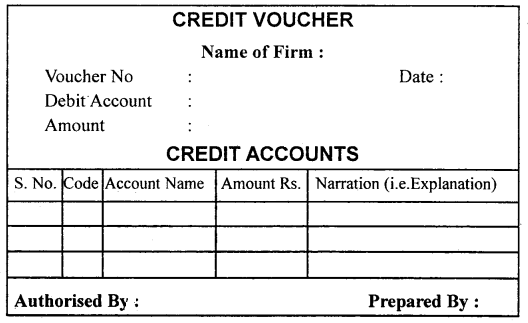
The transaction with multiple debits and multiple credits are called complex transactions and the accounting voucher prepared for such transactions is called a Complex Voucher/Journal Voucher.
Specimen of Complex Transaction Voucher: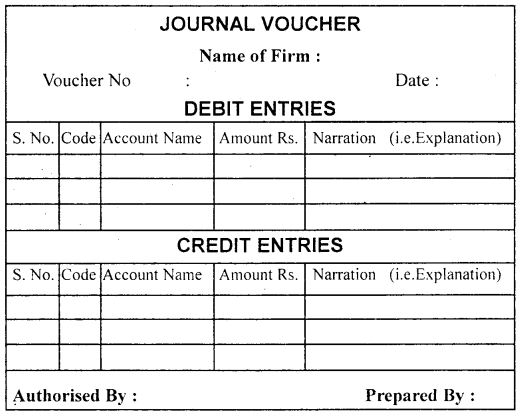
Features of Accounting Voucher:
An accounting Voucher must contain the following essential features:
- It is written on a good quality paper;
- The name of the firm must be printed on the top;
- The date of the transaction is filled up against the date;
- The number of the voucher is to be in serial order;
- The name of the account to be debited or credited is mentioned;
- Debit and the credit amount is to be written in figure against the amount;
- Description of the transaction is to be given account-wise;
- The person who prepares the voucher must mention his name along with his signature;
- The name and signature of the authorized person are mentioned on the voucher.
Accounting Equation:
An accounting equation is a statement of equality between the resources (Assets) and the sources (Capital and Liabilities) which finance the resources. In simple words, an accounting equation signifies that the assets of a business are always equal to the total of its liabilities and capital (owner’s equity) in mathematical form:
Assets = Liabilities + capital
The accounting equation is also called the Balance Sheet Equation, as it depicts fundamental relationship among the components of the balance sheet.
Using Debit and Credit
Every transaction involves a give and takes aspect, in double-entry accounting both the aspect of the transaction is recorded. If the business acquires something, it must have been acquired by giving something. While recording each transaction, the total amount debited must be equal to the total amount credited.
The term ‘Debit’ and ‘Credit’ indicate whether the transaction is to be recorded on the left-hand side or right-hand side of the account. In its simplest form, an account looks like the English language letter “T”. This helps in ascertaining the ultimate position of each item at the end of an accounting period. In a “T” account, the left side is called debit (Dr.) and the right side is called credit (Cr.).
Specimen of T Account: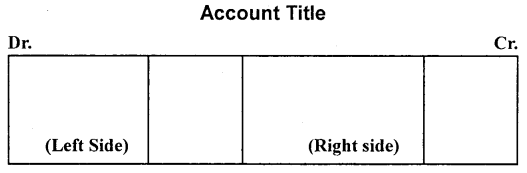
Rules of Debit and Credit: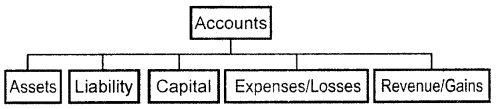
Two fundamental rules are followed to record the changes in these accounts:
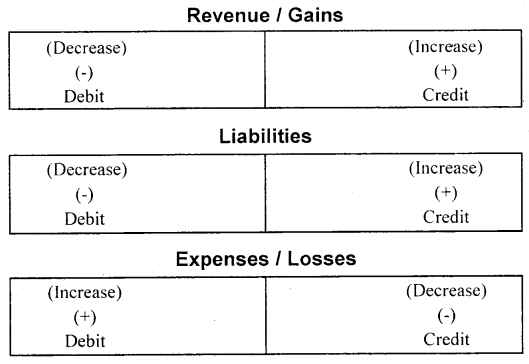
1. For recording changes in Assets/Expenses/Losses
- “Increase in assets is debited and decrease in assets is Credited.”
- “Increase in expenses/losses is debited and decrease in expenses/losses is credited.”
2. For recording changes in Liabilities and Capital/Revenue/Gains.
- “Increase in liabilities is credited and decrease in liabilities is debited.”
- “Increase in the capital is credited and decrease in the capital is debited.”
- “Increase in revenue/gain is credited and decrease in revenue/gain is debited.
The rules applicable to the different kinds of accounts have been summarised in the following chart: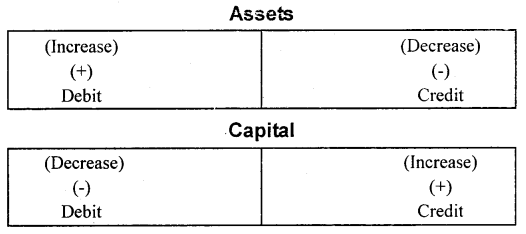
Books of Original Entry:
The book in which the transaction is recorded for the first time is called a journal or book of original entry. The source document is required to record the transactions in the journal. This practice provides a complete record of each transaction in one place and links the debit and credits for each transaction. The process of recording transactions in the journal is called journalizing. The process of transferring journal entry to individual accounts is called posting. This sequence causes the journal to be called the Book of Original Entry and the ledger account on the Principal Book of entry.
Journal is sub-divided into a number of books of original entry as follows:
- Journal proper
- Cash Book
- Other day Books
(a) Purchase Book
(b) Sales Book
(c) Purchase Returns Book
(d) Sales Returns Book
(e) Bills Receivable Book
(f) Bills Payable Book
Journal:
A Journal is a book in which transactions are recorded in the order in which they occur i.e., in chronological order. A Journal is called a book of prime entry (also called of original entry) because all business transactions are entered first in this book.
Format of Journal: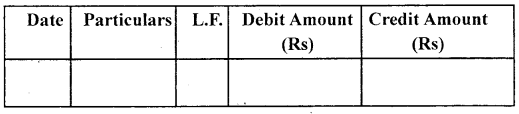
1. Date Column: In this column, the date on which the transaction is entered is recorded. The year and month are written once till they change.
2. Particulars Column: In this column, first the name of accounts to be debited then the names of the account to be credited, and lastly the narration is entered.
3. L.F. (Ledger Folio) Column: In this column, the ledger page number containing the relevant account is entered at the time of posting.
4. Debit amount column: In this column, the amount to be debited is entered.
5. Credit amount column: In this column, the amount to be credited is entered.
The Ledger:
A ledger is a principal book that contains all the accounts (Assets Accounts, Liabilities Accounts, Capital Accounts, Revenue Accounts, Expenses Accounts) to which the transactions recorded in the books of original entry are transferred. As the ledger is the ultimate destination of all transactions, the ledger is called the “Book of Final Entry”.
Format of Ledger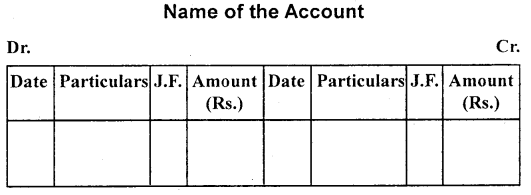
- Name of the Account: The name of the item is written at the top of the format as the title of the account. The title of the account ends with the suffix ‘Account’.
- Dr./Cr.: Dr. means Debit side of the account that is left side and Cr. means Credit side of the account i.e. right side.
- Date: Year, Month, and Date of transactions are posted in chronological order in this column.
- Particulars: The name of the item with reference to the original book of entry is written on the debit/credit side of the account.
- Journal Folio: It records the page number of the original book of entry on which relevant transaction is recorded.
- Amount: This column records the amount in numerical figure, corresponding to what has been entered in the amount column of the original book of entry.
The distinction between Journal and Ledger:
| Journal | Ledger |
| 1. The Journal is the book of the first entry (original entry). | 1. The ledger is the book of secondary entry. |
| 2. It is the book for chronological records. | 2. It is the book for analytical records. |
| 3. It is prepared on the basis of source documents of transactions. | 3. It is prepared on the basis of the journal. |
| 4. Process of recording in the Journal is called Journalising | 4. The process of recording in the ledger is known as posting. |
| 5. Narration is written for each entry. | 5. No narration is given |
Classification of Ledger Accounts: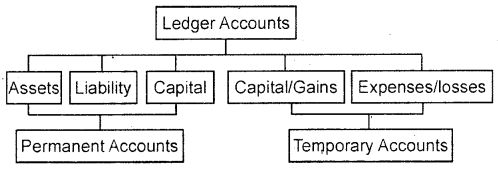
All permanent accounts are balanced and carried forward to the next accounting period. The temporary accounts are closed at the end of the accounting period by transferring them to the trading and profit and loss accounts. This classification is also relevant for preparing financial statements.