Question 1.
Why are some substances biodegradable and some non-biodegradable ? (CCE 2011)
Answer:
Biodegradable substances are substances of organic origin which can be broken down by enzymes of saprophytes, e.g., garbage, sewage, livestock waste, agriculture waste. Non-biodegradable substances are man-made substances which cannot be degraded by saprophytes because they lack the enzymes to do so e.g., waste plastic and polythene articles.
Question 2..
Give any two ways in which biodegradable substances would affect the environment.
(CBSE Delhi 2007, AI 2009 C)
Answer:
- Stink: Within a day or so waste biodegradable substances begin to stink and produce foul gases.
- Pests and Pathogens: The decaying biodegradable substances become breeding places of flies and many other pests. They also contain a number of pathogens. Flies and other pests carry the germs to all the places visited by them resulting in spread of diseases.
Question 3.
Give any two ways in which non-biodegradable substances would affect the environment. (CBSE AI 2009 C)
Answer:
- Dumping Area: Dumping of non-biodegradable substances on a piece of land converts the same into barren land. It is also called landscape pollution.
- Biological Magnification: Pesticides, heavy metals and other chemicals enter water and food chains. They accumulate in toxic proportions and harm all kinds of living organisms. Their concentration also increases with rise in trophic level. Human beings are harmed the most because man lies at the top of every food chain.
Question 4.
What are trophic levels ? Give an example of a food chain and state the trophic levels in it.
Answer:
(a) Trophic Levels. They are steps or divisions of food chain which are characterised by particular methods of obtaining food, e.g., producers (T1), herbivores (T2), primary carnivores (T3), etc.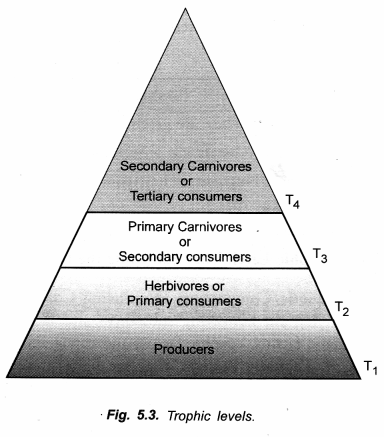
(b) Flow of Energy Through Food Chain. Energy enters a food chain through producers. Producers or green plants trap solar energy and convert it into chemical energy of food during photosynthesis. From producers energy passes into herbivores. A lot of energy dissipates during transfer and utilization of food energy by herbivores (10% law). From herbivores the food energy passes into primary carnivores, again with a lot of dissipation. Only about 10% of herbivore energy is passed into body mass of primary carnivores. From primary carnivores, nearly 10% energy passes into secondary carnivores and so on. It is ultimately lost as heat.
Question 5.
What is the role of decomposers in the ecosystem ?
Answer:
Ecosystem is a self-contained ecological system which consists of a distinct biotic community and the physical environment, both interacting and exchanging materials between them. It is a structural and functional unit of biosphere. Ecosystem is an open system which requires a regular input of energy and circulation of matter for its sustenance. Different ecosystems are in contact with one another. Though they are distinct, but exchange of materials can occur amongst them. Ecosystem can be small (e.g., rotting piece of wood) or large (e.g., forest, ocean), temporary (e.g., rain fed pond) or permanent (e.g., lake, forest), natural or artificial.
Natural Ecosystems: They are ecosystems which develop in nature without human support. Natural ecosystems are of two types, terrestrial and aquatic. Terrestrial ecosystems occur over land. They are of three major types -— desert, grassland and forest. Aquatic ecosystems are found in water bodies, e.g., ponds, lakes, rivers (fresh water), estuaries, marine (salt water).
Artificial Ecosystems: They are ecosystems which have been p/g. 5.7. An aquarium. created and are maintained by human beings. Artificial ecosystems are also called man-made or anthropogenic ecosystems. Agroecosystem is the largest man-made ecosystem. Garden is a common artificial ecosystem maintained by most institutes. It has various types of plants grown and maintained by gardener — grass, trees, flower bearing plants like Rose, Jasmine, Sunflower. A number of animals become residents and visitors of the garden. Aquarium is another artificial ecosystem.
Question 6.
What is ozone and how does it affect any ecosystem ?
Answer:
Definition of Ozone: Ozone is a triatomic molecule made up of three atoms of oxygen, O3.
Effect:
- Protection against ultraVoilet rays if present in stratosphere,
- Ozone dissipates the energy of ultraviolet rays by undergoing dissociation following by reassociation

If present in the atmosphere of ecosystem, it is highly toxic causing injury to mucous membranes, eye irritation and internal haemorrhages in animals and humans. It harms plants by destroying photosynthetic cells producing necrosis.
Question 7.
How can you help in reducing the problem of waste disposal ? Give any tivo methods.
Answer:
Waste disposal is becoming the biggest problem of all local bodies. It is consuming a big chunk of their revenues. Even then the points of collection are turning into stinking areas. Transport of waste to disposal site is seldom perfect. There is stink all the way. A lot of waste is thrown on the roads by the vehicles carrying the waste.
The quantity of waste can be reduced if you form the habit of separation of waste into biodegradable and non-biodegradable parts.
- Non-biodegradable Waste. Most often the non-biodegradable waste is recycled. It is taken away by rag pickers.
- Biodegradable Waste. Biodegradable waste is putressible. It can be composted or vermicomposted to prepare compost for your kitchen gardens. The technique can also be used in schools and other institutions. Some institutes in big cities have installed incinerators for disposal of combustible components of waste. Hospital waste is being compulsorily incinerated to reduce contamination and spread of diseases.
NCERT Chapter End Exercises
Question 1.
Which of the following groups contains only easily biodegradable items ?
(A) Grass, flower and leather
(B) Grass, wood and plastic
(C) Fruit peels, cake and lime juice ,
(D) Cake, wood and grass.
Answer:
(A), (C), (D).
Question 2.
Which of the following constitute a food chain
(A) Grass, wheat and mango
(B) Grass, goat and human
(C) Goat, cow and elephant
(D) Grass, fish and goat.
Answer:
(B).
Question 3.
Which of the following are environment friendly practices ?
(A) Carrying cloth bags to put purchases in while shopping
(B) Switching off unnecessary lights and fans
(C) Walking to school instead of getting your mother to drop you on her scooter
(D) All the above.
Answer:
(D).
Question 4.
What will happen if you kill all the orgainsms in one trophic level ?
Answer:
Higher Trophic Level. All the organisms will be starved and die. Lower Trophic Level. The organisms will increase in number much beyond the carrying capacity of the enviroment. They will become weak and fall easy prey to various diseases, ultimately resulting in decline in population. The ecosystem may get converted into a desert.
Question 5.
- Will the impact of removing all the organisms in a trophic level be different for different trophic levels ?
- Can the organisms of any trophic level be removed without causing any damage to the ecosystem ?
Answer:
- Yes. Impact of removing all the organisms of a trophic level depends upon the trophic level. Removal of producers will kill all the consumers. Killing of carnivores will increase the number of herbivores which in turn will eat up all the producers. They would themselves die of starvation. However, if herbivores are removed, all the carnivores of the area will die. The plants which are dependent upon animals for pollination will fail to reproduce and die ultimately. Others would persist and increase in number, again much beyond the carrying capacity of the environment.
- No. Removal of all the organisms of a trophic level will disturb the ecosystem – killing of higher trophic level organisms and explosion in populations of lower level organisms. Higher number of lower trophic level organisms will adversely affect the ecosystem by consuming whole or major part of their prey.
Question 6.
What is biological magnification ? Will the levels of this magnification be different at different levels of the ecosystem ?
Answer:
Definition: Biological magnification is increase in the concentration of a chemical per unit weight of the organisms with the successive rise in trophic level. In one study it was found that concentration of harmful chemical like DDT will increase 80,000 times the concentration present in water.
Levels of Magnification at Different Levels of Ecosystem. Levels of biomagnification of a chemical will be different at different levels of ecosystem. In one study it was found that concentration of a pesticide was 0.002 ppm in water, 0.05 ppm in plankton, 2.4 ppm in fish and 16.0 ppm in fish eating bird.
Question 7.
What are the problems caused by the nonbiodegradable waste we generate ?
Answer:
- Volume: Being non-biodegradable, the volume of these wastes will not decrease by natural process of decomposition.
- Land Use: They have to be dumped over land. The land becomes unfit for any other purpose.
- Heavy Metals: Heavy metals present in industrial wastes (e.g., copper, lead, chromium, nickel, mercury) remain in the soil indefinitely. Slowly they pass into vegetation and crops harming both humans and animals.
- Pesticides and Other Toxins: They pollute underground water, surface water and soil. The chemicals enter food chain and become concentrated, harming animals and humans.
- Rag Pickers: In the process of removing recyclable materials from solid wastes, the rag pickers are exposed to many diseases and toxins.
- Recycling: Recycling of materials produces only’inferior quality products. Recycling of polythene and plastic is accompanied by release of carcinogenic toxins like dioxins and furans.
Question 8.
If all the waste we generate is biodegradable, will this have no impact on the environment ?
Answer:
The impact on the environment will depend upon the system of collecting, transporting and disposal of biodegradable waste. If it is regular and clean, the impact will be little in urban areas. Only some effect will be observed at disposable site which will emit foul gases and expose the sanitary workers to contamination. The same can also be reduced by increased use of machines and wearing of protective gear by the sanitary workers.
Question 9.
Why is damage to the ozone layer a cause of concern What steps are being taken to limit this damage ?
Answer:
Cause of Concern: Ozone layer present in the stratosphere has thinned out by about 8% over the equator and more so over the antarctica where a big ozone hole appears every year.
This has increased the level of UV-B radiations reaching the earth by 15-20%. These radiations are causing increased number of skin cancers, cataracts and reduced immunity in human beings. There is increased incidence of blinding of animals, death of young ones, reduced photosynthesis, higher number of mutations and damage to articles.
Steps to Limit Damage:
- Ban on production and use of halons.
- Ban on production and use of chlorofluorocarbons.
Selection Type Questions
Alternate Response Type Questions
(True/False, Right(√)/Wrong (x), Yes/No)
Question 1.
Wastes are of two types, biodegradable and non-biodegradable.
Question 2.
Non-biodegradable articles are the ones which cannot be digested.
Question 3.
Ozone is formed in stratosphere by action of ultravoilet radiations on oxygen.
Question 4.
Earth is kept warm due to green house flux.
Question 5.
Rag pickers remove reusable articles.
Question 6.
Pyrolysis is aerobic combustion while incineration is anaerobic combustion.
Question 7.
Biodegradable wastes should be separated and kept in blue colour bins for garbage collectors.
Question 8.
Food web ensures survival of all types of trophic levels.
Matching Type Questions
Question 9.
Match the articles in columns I and II (single matching) :
Column I | Column II |
| (a) Hawk | (i) Producer |
| (b) Hare | (ii) Top carnivore |
| (c) Grass | (iii) Green house gas |
| (d) Carbon dioxide | (iv) Herbivore |
Question 10.
Match the contents of columns I, II and III (double matching)
Column I | Column II | Column III |
(a) Ecosystem (b) Producers (c) Omnivores (d) Persistent pesticide | (i) Food chain (ii) Abiotic components (iii) Transducer (iv) Plant food | p. Food energy q. Biomagnification r. Animal food s. Biotic components |
Question 11.
To what trophic level (T1, T2, T3, T4) do the following belong (key or check list items)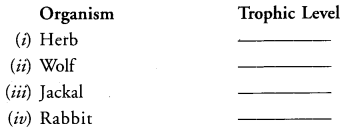
Question 12.
Match each stimulus with appropriate response :
Activity | Deforestation (A) | Increase runoflf (B) | Destruction of wild life (C) |
(i) Hunting (ii) Felling of trees (iii) Litter Collection |
Fill In the Blanks
Question 13. Waste substances that are broken down by microbes are called ………. : ………… .
Question 14. Gardens and crop fields are ………………. ecosystems.
Question 15. Microorganisms are called ……………… as they break down the complex organic remains into simple inorganic substances.
Question 16. Decrease in ozone in stratosphere is linked to release of synthetic chemicals like ……………… .
Question 17. Improvement in life style often results in increased generation of …………. : ………… material.
Answers: