Question 1.
State the location and function of different types ofmeristems.
Solution:
Question 2.
Cork cambium forms tissues that form the cork. Do you agree with this statement? Explain.
Solution:
Sooner or later, another meristematic tissue called cork cambium or phellogen develops, usually in the cortex region. Cork cambium is a couple of layers thick. It is made of narrow, thin-walled, and nearly rectangular cells. Cork cambium cuts off cells on both sides. The outer cells differentiate into cork or phellem while the inner cells differentiate into secondary cortex or phelloderm. The cork is impervious to water due to suberin deposition in the cell wall. The cells of the secondary cortex are parenchymatous. Phellogen, phellem, and phelloderm are collectively known as periderm.
Question 3.
Explain the process of secondary growth in the stems of woody angiosperms with the help of schematic diagrams. What is its significance?
Solution: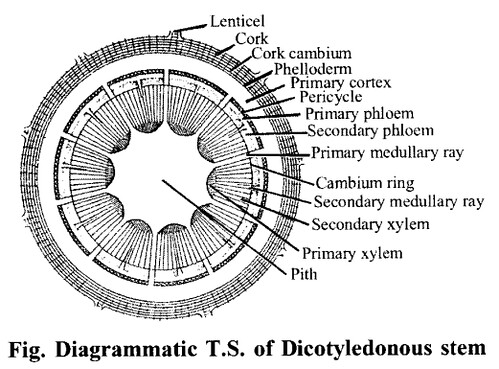
showing secondary growth.
Secondary growth in dicot stem:
- It is a “permanent increase in thickness due to the activity of vascular cambium and cork cambium in stellar and extrasolar regions”. In dicot stem intra fascicular cambium is present.
- The cells of the medullary ray become meristematic and form interfascicular cambium.
- These two cambiums unite and make a complete cambial ring.
- The cells of it divide and produce new cells both on its outer and inner sides.
- The cells formed on the outer side differentiate into secondary phloem while the cells of the inner side form secondary xylem.
- The epidermis is replaced by a secondary protective tissue by an increase in the growth of the stem of the plant. It is made of phellogen (cork cambium).
- It arises from the peripheral cells of the cortex. The phellogen forms new cells on the outer side which make phellem (cork) and phelloderm on its inner side also.
- Significance: Secondary growth increases the girth or thickness of the plant.
- Annual rings of woody angiosperms are very distinct and thus helps in determining the age of the plant.
Question 4.
Draw illustrations to bring out the anatomical difference between
(a) Monocot root and dicot root
(b) Monocot stem and dicot stem
Solution: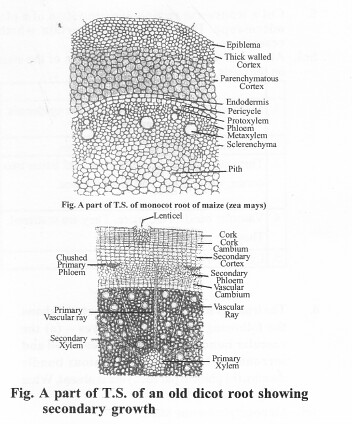

Question 5.
Cut a transverse section of the young stem of a plant from your school garden and observe it under a microscope. How would you ascertain whether it is a monocot stem or a dicot stem? Give reasons.
Solution:
After observing the transverse section of the stem we can differentiate that stem is monocot or dicot on the basis of the following characters: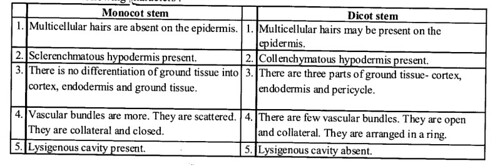
Question 6.
The transverse section of a plant material shows the following anatomical features –
- the vascular bundles are conjoint, scattered, and surrounded by a sclerenchymatous bundle sheath,
- phloem parenchyma is absent What will you identify it as?
Solution:
The transverse section of a typical young monocotyledonous stem shows that
- The vascular bundles are conjoint, scattered, and surrounded by sclerenchymatous bundle sheaths
- Phloem parenchyma is absent, and water containing cavities are present within the vascular bundles.
Question 7.
Why xylem and phloem are called complex tissues?
Solution:
Xylem and phloem a composed of several types of cells and they work as a unit. Hence they are called complex tissues.
Question 8.
What is the stomatal apparatus? Explain the structure of stomata with a labelled diagram.
Solution:
- Several minute openings or stomata are found on the epidermis of all the green aerial parts of plants but are abundant on the lower surface on the leaves as they regulate the process of transpiration.
- A large number of stomata occur on the upper surface of leaves of aquatic plants.
- Each stomata is surrounded by two cells known as the guard cells. In the dicotyledons plants these are bean-shaped, but in sedges and grasses these are dumb-bell-shaped.
- The guard cell is living. Their outer walls are thin where as the inner ones surrounding the aperture are highly thickened.
- Due to this variation in the thickening, the guard cell may become turgid and flaccid, depending upon the supply of water in them, which makes the opening and closing of stomata possible.
- Some times a few neighbouring epidermal cells in the vicinity of guard cells become specialized in their shape and size and contents. These are known as subsidiary cells.
- The stomatal aperture, guard cells and the surrounding subsidiary cell are together called stomatal apparatus.
Question 9.
Name the three basic tissue systems in the flowering plants. Give the tissue names under each system.
Solution:
On the basis of their structure and location, there are three types of tissue systems. These are the
- Epidermal tissue system,
- The ground or fundamental tissue system and
- The vascular or conducting tissue system.
1. Epidermal tissue system The epidermal tissue system forms the outer-most covering of the whole plant body and comprises epidermal cells, stomata, and the epidermal appendages the trichomes, and hairs.
2. All tissues except epidermis and vascular bundles constitute the ground tissue. It consists of simple tissues such as parenchyma, collenchyma, and sclerenchyma.
3. The vascular system consists of complex tissues, the phloem, and the xylem. The xylem and phloem together constitute vascular bundles.
Question 10.
How is the plant anatomy useful to us?
Solution:
‘The study of plant anatomy is useful in many ways. First of all the study helps us understand the way a plant functions carrying out its routine activities like transpiration, photosynthesis, and growth and repair. Second, it helps botanists and agriculture scientists to understand the disease and cure for plants. Plants are important to maintain the ecological balance of the earth, so understanding plant anatomy is a way to understand the large system of the ecology on this planet.
Question 11.
What is periderm? How does periderm formation take place in the dicot stems?
Solution:
Phellogen, phellem, and phelloderm are collectively known as periderm. Phellogen develops, usually in the cortex region. Phellogen is a couple of layers thick. It is made of narrow, thin-walled, and nearly rectangular cells. Phellogen cuts off cells on both sides. The outer cells differentiate into cork or phellem while the inner cells differentiate into secondary cortex or phelloderm. The cork is impervious to water due to suberin deposition in the cell wall. The cells of the secondary cortex are parenchymatous.
Question 12.
Describe the internal structure of a dorsiventral leaf with the help of labelled diagrams.
Solution:
Dorsiventral (dicotyledonous) leaf: The vertical section of a dorsiventral leaf through the lamina shows three main parts, namely, epidermis, mesophyll, and vascular system.
Epidermis: The epidermis which covers both the upper surface (adaxial epidermis) and lower surface (abaxial epidermis) of the leaf has a conspicuous cuticle. The abaxial epidermis generally bears more stomata than the adaxial epidermis. The latter may even lack stomata.
Mesophyll:
- The tissue between the upper and the lower epidermis is called the mesophyll.
- It possesses chloroplasts and carries out photosynthesis, is made up of parenchyma.
- It has two types of cells – the palisade parenchyma and the spongy parenchyma.
- The adaxially placed palisade parenchyma is made up of elongated cells, which are arranged vertically and parallel to each other.
- The oval or round and loosely arranged spongy parenchyma is situated below the palisade cells and extends to the lower epidermis.
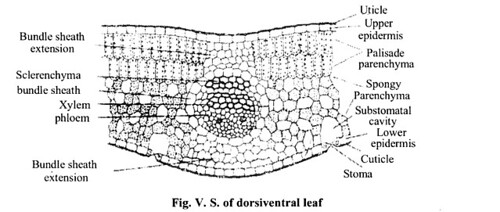
6. There are numerous large spaces and air cavities between these cells.
Vascular system:
- This includes vascular bundles, which can be seen in the veins and the midrib.
- The size of the vascular bundles is dependent on the size of the veins.
- The veins vary in thickness in the reticulate venation of the dicot leaves. The vascular bundles are surrounded by a layer of thick-walled bundle sheath cells.
VERY SHORT ANSWER QUESTIONS
Question 1.
Vascular bundles having cambium are known as.
Solution:
Open, Vascular bundle
Question 2.
Name the two types of sclerenchyma.
Solution:
Sclerenchyma fibers and stone cells.
Question 3.
From where do the secondary meristems originate?
Solution:
Permanent tissue.
Question 4.
What does make the root apical meristem subterminal?
Solution:
The presence of the root cap makes the root apical meristem subterminal.
Question 5.
Where are companion cells located in flowering plants? What are their functions?
Solution:
Companion cells are located in phloem cells of vascular tissues, they support the sieve tubes in water conduction.
Question 6.
What is the advantage of lignocellulose in the wall of the xylem?
Solution:
It provides rigidity, thickness, and resistance
Question 7.
A cross-section of a plant material shows the following features under the microscope: vascular bundles are radially arranged. These are found xylem strands showing exarch condition. What type of plant part of is this?
Solution:
Dicot root.
Question 8.
Based on position, classify various types of meristems
Solution:
Apical, intercalary and lateral meristems.
Question 9.
Name the various component cells of xylem. Which of them does not have a nucleus?
Solution:
Tracheids, vessels, xylem parenchyma andxylem fibres. Only xylem parenchyma have nucleus and living.
Question 10.
Give an example of a secondary meristem.
Solution:
Examples of secondary meristem are cork cambium and interfascicular cambium.
Question 11.
Name the tissue involved in linear and lateral growth in plants.
Solution:
Linear growth is caused by apical meristem and lateral growth is caused by lateral meristem.
Question 12.
Heartwood is more durable than springwood. Why?
Solution:
Heartwood is more durable than spring wood due to its little susceptibility to the attack of pathogens and insects.
Question 13.
Where these present:
- Hypodermis layer
- Mesophyll tissue
- Stomata
- Cambium
Solution:
- Hypodermis layer – is found in stems
- Mesophyll tissue – in leaves
- Stomata – lower epidermis in leaves
- CambiumIn vascular bundles which are open
SHORT ANSWER QUESTIONS
Question 1.
What are the differences between root hairs and stem hairs?
Solution:
The main difference between stem hairs and root hairs are :
.
Question 2.
Draw well labelled diagrams of the T.S. of dicotyledonous leaf.
Solution: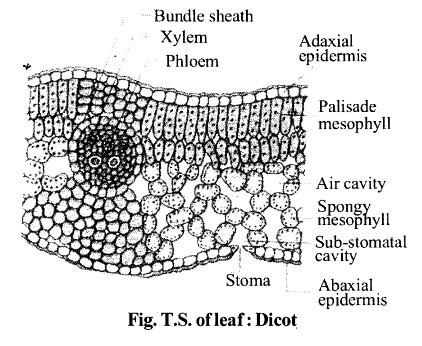
Question 3.
Why is cambium considered to be a lateral meristem?
Solution:
Cambium is responsible for the increase in the thickness of stems and roots as a result of the addition of secondary tissues (secondary cortex, secondary phloem and secondary xylem). They are located at the lateral position so-known as lateral meristems.
Question 4.
Name the plant part in which the endodermis is absent. Give one basic difference between the endodermis and epidermis.
Solution:
The endodermis is absent in leaves. Cells of endodermis possess Casparian strips or bands in their radial and transverse walls which are not found in the epidermis.
Question 5.
What are Casparian strips?
Solution:
These are thickenings of lignin and suberin formed around the lateral walls of the endodermis to prevent plasmolysis.
Question 6.
Which tissue is most abundantly found in plants? Where all is it present in plants?
Solution:
The tissue most abundantly found in plants is parenchyma. It is found in pith, cortex, and in entire mesophyll of the leaves.
Question 7.
What is present in the phloem of leaves besides sieve elements and is it living or dead? How are these functional & used?
Solution:
Besides sieve elements, in phloem parenchyma, living cells are present. These store food other cells are phloem fibres that are dead and provide mechanical strength. These are also used in making ropes and coarse textiles.
LONG ANSWER QUESTIONS
Question 1.
Describe the structure and functions of xylem tissues in angiosperm plants.
Solution:
- Xylem is a complex tissue. It forms a part of the vascular bundle.
- It is mainly concerned with the conduction of water and minerals. It also provides mechanical support to the plant.
- As a conducting strand, xylem forms a continuous channel through the roots, stem, leaves and other aerial parts.
- It consists of four different types of cells—xylem vessels, trachieds, xylem fibres and xylem parenchyma.
- Xylem vessels and tracheids are concerned with the conduction of water and minerals from roots to aerial parts of the plant.
- Xylem fibres provide mechanical strength to the plant body. Xylem parenchyma are the only living components of xylem.
- These are concerned with the storage of food and other vital functions.
Question 2.
What is collenchyma? Explain its structure and function in the plant body of a herbaceous angiosperm.
Solution:
- The cells of collenchyma are somewhat elongated with cellulose thickening, found as longitudinal strips.
- These are usually confined to the comers of the cells.
- Collenchyma cells appear circular, oval or angular in the transverse section. Internally, each cell possesses a large 4 central vacuole, peripheral cytoplasm and a nucleus.
- Collenchyma is usually found beneath the epidermis in stem, petiole and leaves of herbaceous dicot plants. It is usually absent in monocot stems and monocot roots.
Functions:
- It provides tensile strength and rigidity to the plants due to thickening.
- Chloroplasts containing collenchyma cells are responsible for photosynthesis.
- Collenchyma also provides elasticity to the plant organs.
- Collenchyma are alive and also stores food.
Question 3.
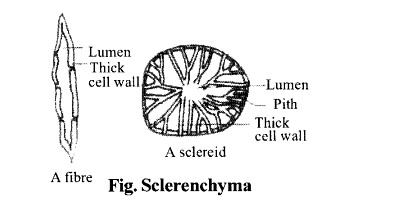
Explain sclerenchyma with a well labelled diagram.
Solution:
Sclerenchyma is a simple permanent tissue. It consists of two types of cells. They are sclerenchyma fibres and sclereids.
(a) Sclerenchyma fibres –
- These are much elongated fibers with tapering ends.
- On ipaturity, they lose their protoplasm and become dead. Their cell wall is made up of cellulose or lignin, or both.
- Central cavity of the cell is greatly reduced due to the formation of secondary thickening. Sclerenchyma provides mechanical strength to the plants.
- They help in conduction when present in the secondary xylem.
(b) Sclereids –
- They develop from ordinary parenchyma cells by the deposition of lignin.
- These cells are thick-walled and highly lignified and become dead on maturity.
- They are broader as compared to fibers and their cell lumen is veiy narrow.
- Sclereids protect the plant from environmental forces like a strong wind.
- They provide mechanical strength and rigidity to the plant.
Question 4.
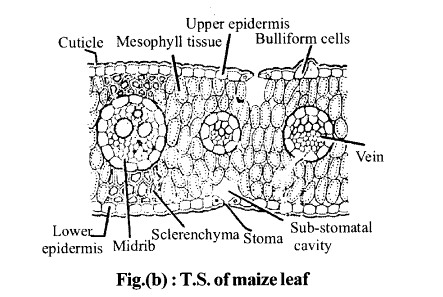
Describe the structure of a monocotyledonous leaf.
Solution:
Anatomy of Monocot/isobilateral leaf: The upper and lower surfaces are covered by a single-layered epidermis.
- The upper epidermis has some cells larger than the others; such large cells are known as bulliform/motor cells.
- Stomata are found on both upper and lower epidermal layers. The mesophyll is not differentiated into palisade and spongy parenchyma.
- Mesophyll cells are isodiametric and are arranged compactly; they contain a number of chloroplasts. Since monocot leaves have parallel veins, a number of vascular bundles can be seen in a row in the section.
- Each vascular bundle has sclerenchyma cells (caps) on its upper and lower edges.
- The xylem is on the upper side and the phloem on the lower side. There is a parenchymatous bundle sheath, which often contains chloroplasts and performs the function of photosynthesis.
Question 5.
Give two examples & salient features of
(1) Simple Tissue
(2) Complex Tissue
Solution:
(1) Simple Tissue:
(i) Parenchyma
(ii) Collenchyma
(2) Complex Tissue:
(i) Xylem
(ii) Phloem
(1) Simple Tissue:
(i) Parenchyma: These are living, thin-walled cells. It is used for storage of food, induction of substances, provides turgidity to softer parts of the plants
(ii) Collenchyma: These are longer than parenchyma. These are living mechanical tissue, it provides mechanical strength to organs and is present in peripheral position in plants to resist bending my the mind.
(2) Complex Tissue:
(i) Xylem: This is also called Hadrome, which is a water-conducting tissue. It is made up of cells like tracheids, xylem fibers, and xylem parenchyma only xylem parenchyma is living and all others are dead.
(ii) Phloem: This is also called Bast, which is a conducting tissue of food from leaves to all parts of the body. The parts of phloem are sieve elements, companion cells, phloem fibres, and phloem parenchyma. Phloem fibres are dead while parenchyma is living. Together these perform their function.