Question 1.
What is meant by a pure substance?
Answer:
In terms of science, a pure substance may be defined as a single substance or matter which cannot be separated into other kinds of matter by any physical process. All pure elements and compounds are pure substances.
Question 2.
List points of differences between homogeneous and heterogeneous mixtures.
Answer: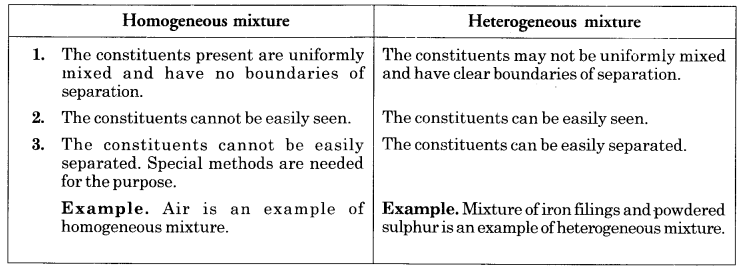
Question 3.
How are sol, solutions and suspension different from each other ?
Answer: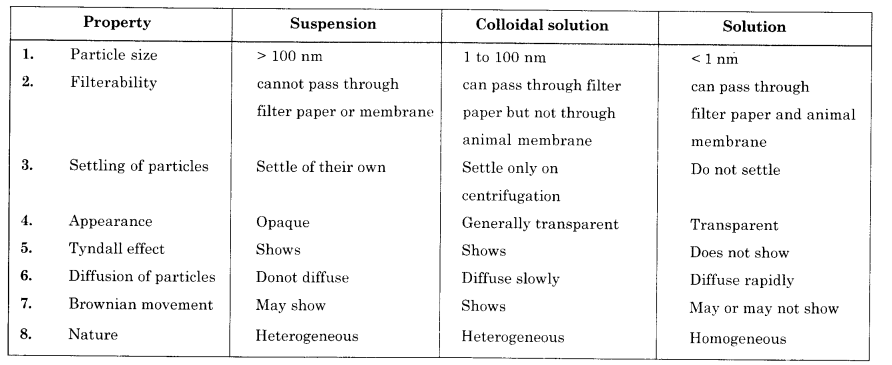
Question 4.
To make a saturated solution, 36 g of sodium chloride is dissolved in 100 g of water at 293 K. Find its concentration at this temperature.
Answer: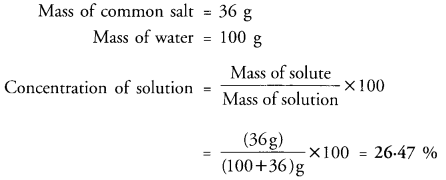
Question 5.
How will you separate a mixture containing kerosene and petrol (difference in their boiling points is more than 25°C) which are miscible with each other ?
Answer:
The separation can be done by applying process of simple distillation. Both are miscible liquids. Since the difference in the boiling points is less than 25 K, the separation can be done with the help of fractional distillation technique. Petrol with less boiling point distils first leaving behind kerosene in the distillation from flask.
Question 6.
Name the technique to separate
- butter from curd
- salt from sea water
- camphor from salt.
Answer:
- The separation can be done by carrying centrifugation in a centrifugal machine.
- The separation can be done either by crystallisation or by evaporation.
- The process of sublimation helps in separating camphor from salt. Camphor undergoes sublimation.
Question 7.
What types of mixtures can be separated by technique known as crystallisation ?
Answer:
The solid mixtures in which one component or impurity is less soluble in a particular solvent as compared to the other. For example, impure samples of copper sulphate, potassium nitrate, potash alum etc. can be purified by this method.
Question 8.
Classify the following into physical and chemical changes.
- Cutting of trees
- Melting of butter in a pan
- Rusting of almirah
- Boiling of water to form steam
- Passing of electric current through water and the water breaking down into hydrogen and oxygen gases
- Dissolving common salt in water
- Making of fruit salads with raw fruits
- Burning of paper and wood.
Answer:
Please note that a change which can be easily reversed is a physical change while the one which cannot be reversed is a chemical change in nature. Based on this concept, the changes that are listed may be classified as :
- Chemical change
- Physical change
- Chemical change
- Physical change
- Chemical change
- Physical change
- Physical change
- Chemical change.
Question 9.
Try to segregate the things around you as pure substances and mixtures :
(a) distilled water
(b) curd
(c) diamond
(d) ice cream
(e) kerosene
(f) cooking oil
(g) steel
(h) graphite
(i) raw rubber
(j) vulcanised rubber
(k) solder wire.
Answer:
Pure substances : Distilled water, diamond, graphite, raw rubber
Mixtures : curd, ice cream, kerosene oil, cooking oil, steel, vulcanised rubber, solder wire (alloy of lead and tin)
NCERT END EXERCISE
Question 1.
Which separation techniques will you apply for the separation of the following ?
- Sodium chloride from its solution in water. (CBSE 2012)
- Ammonium chloride from a mixture containing sodium chloride and ammonium chloride.
- Small pieces of metal in the engine oil of a car. (CBSE 2012, 2013, 2014)
- Different pigments from an extract of flower petals.
- Butter from curd.
- Oil from water. (CBSE 2012, 2013)
- Tea leaves from tea.
- Iron pins from sand.
- Wheat grains from husk. (CBSE 2012)
- Fine mud particles suspended in water. (CBSE 2012, 2013)
Answer:
- Evaporation : Water will evaporate leaving behind sodium chloride.
- Sublimation : Ammonium chloride will be collected as sublimate.
- Filtration : Pieces of metal can be separated by filtration.
- Chromatography : Pigments (coloured components) from the extract of flower plants can be separated by chromatography.
- Centrifugation : Butter will get separated upon centrifugation.
- Separating funnel : Oil and water can be separated by the use of separating funnel.
- Filtration : Upon filtration through a sieve, tea leaves will be collected on the sieve.
- Magnetic separation : A magnet will attract iron pins and not sand particles.
- Sieving : Wheat grains from husk can be separated with the help of sieve.
- Sedimentation : As a result of sedimentation, mud particles will settle as precipitate. It can be separated later on by filtration.
Question 2.
Write the steps you would use for making tea. Use the words-solution, solvent, solute, dissolve, soluble, insoluble, filtrate and residue.
Answer:
Tea can be prepared in the steps given ahead :
- Take approximately two to three cups of water (solvent) in a pan and heat it on a gas burner.
- When water starts boiling, add desired amount of milk and sugar (both are solutes).
- Now, stir with a spoon. As a result, sugar will dissolve and milk will become miscible with water. A solution will be formed.
- Further boil the solution for sometime so that sugar may completely dissolve.
- Now add the required amount of tea leaves (solute) to the pan. Boil again and filter through a sieve. Tea will be collected as filtrate. Tea leaves will get collected on sieve as residue.
Question 3.
Pragya tested the solubility of four different substances at different temperatures and collected the data as given below (results are given in the following table, as grams of substance dissolved in 100 grams of water to form a saturated solution).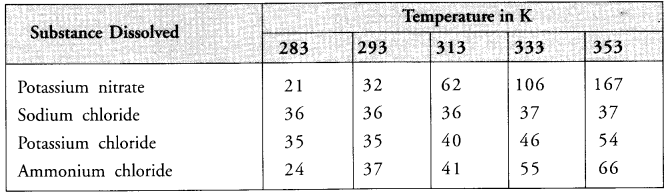
(a) What mass of potassium nitrate would be needed to produce a saturated solution of potassium nitrate in 30 grams of water at 313 K ?
(b) Pragya makes a saturated solution of potassium chloride in water at 353 K and leaves the solution to cool at room temperature. What would she observe as the solution cools ? Explain.
(c) Find the solubility of each salt at 293 K. Which salt has the maximum solubility at this temperature ?
(d) What is the effect of change of temperature on the solubility of a salt ?
Answer:
(a) At-313 K, in the saturated solution
(b) When the saturated solution prepared at 353 K is cooled to room temperature (about 298 K) the solubility of potassium chloride in water will decrease. It will slowly start separating as a crystalline white residue at the bottom of the container.
(c) The solubility of the salt in a water is defined as :
the maximum amount of the salt which is dissolved in 100 g of water (or any other solvent) to form a saturated solution at a given temperature
In the light of this, at 293 K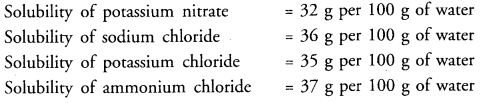
(d) With rise in temperature, the solubility of all the salts in water increases. This has been shown by the data given in the table. Similarly, when the temperature is decreased, the solubility of these salts in water decreases.
Question 4.
Explain the following, giving examples :
(a) Saturated solution
(b) Pure substance
(c) Colloid
(d) Suspension.
Answer:
(a) Saturated solution: A solution becomes saturated if the solute starts separating at the bottom of the container in which the solution is being prepared at a given temperature. A saturated solution generally becomes unsaturated upon heating.
(b) Pure substance: A pure substance means a single substance (or matter) which cannot be separated into other kinds of matter by any physical process.
(c) Colloid: Colloidal solutions are also heterogeneous in nature like suspensions, but they have smaller size of the particles which are distributed. It ranges between 1 nm to 100 nm i.e., in between the particle size of true solution and suspension.
(d) Suspension: A suspension may be defined as a heterogeneous mixture in which the solid particles are spread throughout the liquid without dissolving in it. They settle as precipitate if the suspension is left undisturbed for sometime.
Question 5.
Classify each of the following as a homogeneous or heterogeneous mixture :
(a) Soda water
(b) Wood
(c) Air
(d) Soil
(e) Vinegar
(f) Filtered tea.
Answer:
Homogeneous mixture : Soda water, air, vinegar, filtered tea.
Heterogeneous mixture : Wood, soil.
Air is a homogeneous mixture of different gases. However, if some dust or other particles are present, then air becomes a heterogeneous mixture.
Question 6.
How would you confirm that the colourless liquid given to you is pure water ?
Answer:
This can be confirmed by the following experiments :
- Filter the colourless liquid through a very fine filter paper. If no residue is left on the filter paper, this means that the liquid is pure water and has no suspended inpurities present in it.
- Evaporate the colourless liquid in a china dish or beaker. In case no residue is left, this means that it is pure water and has no dissolved impurities present in it.
- Determine the boiling point of pure liquid. If it comes out to be nearly 373 K (100°C), this means that the pure liquid is water.
Question 7.
Which of the following materials fall in the category of pure substances ?
(a) Ice
(b) Milk
(c) Iron
(d) Hydrochloric acid
(e) Calcium oxide
(f) Mercury
(g) Brick
(h) Wood
(i) Air.
Answer:
Pure substances in the given list of materials are :
(a) Ice (compound)
(c) Iron (element)
(e) Calcium oxide (compound)
(f) Mercury (element).
Both milk and hydrochloric acid are homogeneous mixtures. Please note that the acid is formed when the vapours of hydrogen chloride gas are passed through water.
Wood and air (containing suspended particles) are heterogeneous mixtures. However, air free from any suspended particles is a homogeneous mixture.
Question 8.
Identify the solutions among the following mixtures :
(a) Soil
(b) Sea water
(c) Air
(d) Coal
(e) Soda water.
Answer:
By definition, a solution or homogeneous mixture is the mixture of two or more non-reacting substances present in a single phase. In the light of this, the solutions among the following are :
(b) Sea water
(c) Air
(e) Soda water.
Question 9.
Which of the following will show “Tyndall effect” ?
- Salt solution
- Milk
- Copper sulphate solution
- Starch sol.
Answer:
Tyndall effect is shown by colloidal sol. Since milk and starch sol are colloidal sol therefore, these will show Tyndall effect.
Question 10.
Classify the following into elements, compounds and mixtures :
- Sodium
- Soil
- Sugar solution
- Silver
- Calcium carbonate
- Tin
- Silicon
- Coal
- Air
- Soap
- Methane
- Carbon dioxide
- Blood.
Answer:
Elements : Sodium, Silver, Tin and Silicon
Compounds : Calcium carbonate, Methane, Carbon dioxide.
Mixtures : Soil, Sugar solution, Coal (as percentage of carbon varies), Air, Blood, Soap.
Question 11.
Which of the following are chemical changes ?
- Growth of a plant
- Rusting of iron
- Mixing of iron filings and sand
- Cooking of food
- Digestion of food
- Freezing of water
- Burning of a candle.
Answer:
Chemical changes are : Growth of a plant, Rusting of iron, Cooking of food, Digestion of food, Burning of a candle.
NCERT Solutions for Class 9 Science Chapter 2 Very Short Answer Questions
Question 1.
A shining thick liquid is often used in glass thermometers. Name it.
Answer:
The shining liquid is mercury. It is used in glass thermometers as it does not stick to glass.
Question 2.
Name two metals which are both malleable and ductile.
Answer:
Copper and silver are both malleable and ductile.
Question 3.
A diamond knife is quite often used for cutting glass. Why ?
Answer:
Diamond is probably the hardest substance known. Therefore, a knife made from a special type of diamond is used for cutting glass.
Question 4.
Flow will check the purity of a pure chemical compound in the solid state ?
Answer:
The purity of a pure chemical compound can be checked by finding its melting point experimentally and by comparing it with its standard melting point value available in the form of tables. In case, the two values are nearly the same, the substance is pure. Otherwise, it is not.
Question 5.
A hard substance when bent produces a tinkling sound. Predict its nature.
Answer:
The hard substance is a metal. Actually metals are sonorous and produce tinkling sound when bent.
Question 6.
Give one test to show that brass is a mixture and not a compound.
Answer:
When we try to melt brass, it does not have a sharp melting point. This shows that it is not a compound. It is a homogeneous mixture of copper and zinc and is called alloy.
Question 7.
To the already prepared solution of a solute A’ prepared in water, a small amount of A is added. However, it does not dissolve. What does it indicate ?
Answer:
This indicates that the solution of the substance A in water is of saturated nature. It is called saturated solution.
Question 8.
What is the range of the size of the particles of dispersed phase in a colloidal solution ?
Answer:
It ranges from 1 nm (10~9 m) to 100 nm (10~7 m).
Question 9.
When a beam of light was passed through the solution of a substance A dissolved in water, the path of light could be seen. Predict the nature of the solution.
Answer:
The solution of substance A in water is colloidal solution. The colloidal particles scattered the light when it was passed through the solution due to Tyndall effect.
Question 10.
What will happen if a colloidal solution of sulphur is centrifuged in a centrifugal machine for sometime.
Answer:
The yellow precipitate of sulphur will settle at the bottom of the tube and the solution collected above the precipitate will be colourless.
Question 11.
How will you justify that rusting of iron is a chemical change ?
Answer:
The rust is a brown chemical compound known as hydrated ferric oxide (Fe2O3.xH2O). It can not be removed from the surface of the metal by any means. Formula of rust shows that iron has undergone a chemical change.
Question 12.
Why do not the dispersed phase particles in a colloidal solution combine with one other ?
Answer:
They donot come closer because of the presence of either positive or negative charge on them. Due to mutual repulsion, these particles remain scattered in a colloidal solution.
Question 13.
What are the units of mass percent ?
Answer:
Mass percent has no units as it is simply a ratio.
Question 14.
What is the nature the solution formed by mixing mustard oil and water ?
Answer:
It is a colloidal solution known as emulsion.
Question 15.
Give one example of the colloidal solution in which solid acts as the dispersed phase and gas as the dispersion medium.
Answer:
Dust storm in which solid particles are dispersed in air.
Question 16.
Name two compounds which sublime on heating.
Answer:
Ammonium chloride and iodine crystals.
Question 17.
You are provided with a mixture of carbon tetrachloride and water. How will you separate the constituents ?
Answer:
Both are immiscible liquids. The separation can be done by the use of a separating funnel.
Question 18.
Give one example of
(a) solution of a gas in a liquid
(b) solution of number of gases.
Answer:
(a) An aqueous solution of ammonia
(b) Air.
Question 19.
What is disperssed phase and dispersion medium in a colloid ?
Answer:
If a colloidal solution is compared to an ordinary solution, then dispersed phase is comparable to the solute and dispersion medium to the solvent.
Chapter 2 Science Class 9 Short Answer Questions
Question 20.
What happens when a saturated solution of sodium chloride prepared at 60°C is allowed to cool at room temperature ? (CBSE 2013)
Answer:
A small amount of the salt gets separated at the bottom of the container as a residue.
Question 21.
Can a mixture of alcohol and water be separated with the help of a separating funnel ?
Answer:
No, it is not possible because alcohol (ethyl alcohol) and water are completely miscible. They do not form separate layers. Therefore, their separation cannot be done with the help of a separating funnel.
Question 22.
Sodium chloride contains two elements, but it is still a pure substance. Assign reason.
Answer:
The two elements sodium and chlorine have combined with each other by chemical reaction to form sodium chloride (NaCl) which is a chemical compound. Since these elements cannot be separated from each other by any physical process, sodium chloride is a pure substance.
Question 23.
What types of mixtures are represented by the following ?
(a) Carbon dioxide gas dissolved in water.
(b) Air containing suspended particles.
(c) Soap bubbles formed by blowing air into soap solution.
Answer:
(a) homogeneous
(b) heterogeneous
(c) heterogeneous.
Question 24.
Two miscible liquids A and B are present in a solution. The boiling point of A is 60°C while that of B is 90°C. Suggest a method to separate them.
Answer:
The separation can be done by the process of simple distillation. The vapours of the liquid A will rise in the flask when heated to a temperature of 60°C. They will pass through the condenser and will collect as “ distillate. The liquid B with higher boiling point will remain in the flask.
Question 25.
Classify the following as homogeneous and heterogeneous mixtures :
- Copper sulphate solution
- A suspension of chalk in water
- Dust storm
- A dilute solution of alcohol in water.
Answer:
- homogeneous
- heterogeneous
- heterogeneous
- homogeneous.
Question 26.
Solubility of KNO3 at 313 K is 62 g. What mass of KNO3 would be needed to produce a saturated solution of KNO3 in 50 g of water at 313 K ?
Answer:
By definition of a saturated solution.
100 g of water at 313 K contain KNO3 = 62 g 50 g of water at 313 K contain KNO3 = 31 g
Question 27.
(a) State one property in which a solution of sugar in water resembles a mixture of sugar and sand and one property in which it differs from it.
(b) You are given two liquids; one a solution and the other a compound. How will you distinguish the solution from the compound ?
Answer:
(a) Resemblance : Both of them taste sweet due to the presence of sugar.
Difference : The constituent particles cannot be seen in the mixture of sugar and water but they can be easily seen in the mixture of sugar and sand.
(b) Try to separate the constituents present in both by some suitable physical method. Separation is possible in case of a solution but not in a compound.
Question 28.
What would you observe when :
(a) A saturated solution of potassium nitrate prepared at 60°C is allowed to cool to room temperature ?
(b) A mixture of iron filings and sulphur is heated strongly ?
(c) A colloidal solution of starch is passed through an ordinary filter paper ?
Answer:
(a) Crystals of potassium nitrate which are needle shaped would slowly appear at the bottom of the container which may be a china dish or a beaker.
(b) A greyish-black mass passes formed.
(c) The solution passes through the ordinary filter paper without leaving any residue.
Question 29.
The teacher instructed three students A, B and C respectively to prepare a 50% (mass by volume) solution of sodium hydroxide (NaOH). A dissolved. 50 g of NaOH in 100 mL of water. B dissolved 50 g of NaOH in 100 g of water. The student C dissolved 50 g of NaOH in water to make 100 mL of solution. Which one of them has made the desired solution and why ? (CBSE 2014)
Volume of water = (250 – 150) = 100 mL
Answer:
The student ‘C’ has made the desired solution.
Question 30.
Point out whether the following statements are true or false :
- Particles in a colloidal solution can always be seen by naked eyes.
- Scattering of light occurs when a beam of liquid is passed through aqueous sugar solution.
- Colloidal solutions are of heterogeneous nature.
- Digestion of food is a chemical change.
Answer:
- False
- False
- True
- True.
Question 31.
Calculate the mass of potassium sulphate required to prepare its 10 percent (mass percent) solution in 100 g of water.
Answer: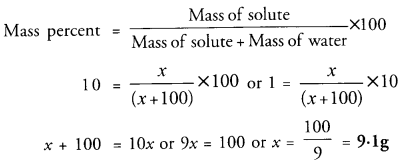
Question 32.
What volumes of ethyl alcohol and water must be mixed together to prepare 250 mL of 60 percent volume by volume solution of alcohol in water ?
Answer: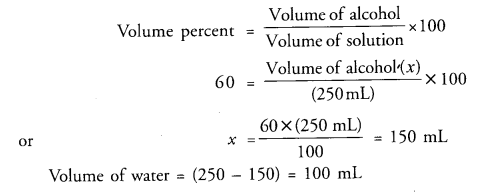
Question 33.
(a) Two students Ramesh and Alka were required to prepare 10 percent (mass/mass) solution of sodium chloride in water. For that, Ramesh dissolved 10 g of the salt in 100 g of water while Alka dissolved 10 g of the salt in 100 g of the solution. Which out of the two prepared the correct solution ?
(b) You are given a solution of a substance ‘A’. How will you test whether it is saturated or unsaturated with respect to A at a given temperature ?
Answer:
(a) Alka prepared the correct solution because by definition 10 percent solution of a substance means a solution containing 10 g of the solute dissolved in 100 g of it. This means that the mass of water in the solution is 90 g.
(b) Take the given solution in a beaker. Now add small amount of A to this solution and stir with a glass rod. If it dissolves in this solution, this means that the solution is unsaturated. If it does not dissolve and separates as a solid at the bottom of the beaker, the solution is saturated in nature.
Question 34.
What are solute and solvent in aereated drinks ?
Answer:
In aerated drinks, carbon dioxide (solute) is dissolved in water (solvent). It is infact, a homogeneous mixture.
Question 35.
How much water should be mixed with 12 mL of alcohol so as to obtain 12% alcohol solution ?
Volume of solute (alcohol)
Answer:
Question 36.
(a) All mixtures are homogeneous. Is this statement correct ? Justify your answer.
(b) How can a saturated solution be made unsaturated ?
Answer:
(a) No, this statement is wrong. Mixtures can be homogeneous only if the constituents present are uniformly mixed and there is no boundary of separation of these constituents.
A mixture is said to be heterogeneous if it does not have a uniform composition and also has visible boundaries of separation between the constituents.
A few examples of heterogeneous mixtures are listed. A mixture of sand and common salt is regarded as a heterogeneous mixture. No doubt, these are present in the same phase i.e., solid phase but have clear boundaries of separation. The particles of sand and common salt can be easily seen in the mixture.
(b) A saturated solution can be made unsaturated in two ways :
- By increasing the temperature or by heating
- By adding more of the solvent or by diluting the solution.
Question 37.
- Name a non-metallic element found in
- liquid state
- gaseous state.
- Pick metalloid from the elements carbon, silicon, phophorus, gold.
- Which two properties of metals enable us to give the desired shapes to metals ?
Answer:
- Bromine (Br2)
- Oxygen (O2).
- Silicon (Si) is a metalloid.
- Metals are melleable and ductile, i.e. they can be beaten into sheets and drawn into wires.
Question 38.
Why does a salt disappear when dissolved in water ?
Answer:
Water helps in separating ions from a salt. This inter-ionic forces decreases and the ions gets dispersed. Therefore salt dissolved in water and disappears.
Question 39.
(a) Name a metal which is liquid at room temperature.
(b) Smoke and fog are aerosols. How do they differ from each other?
(c) Name an element which melts when kept on the palm.
Answer:
(a) Metal is mercury(Hg)
(b) In smoke, dispersed phase is a solid (dust or carbon particles). In aerosols, it is a liquid (water drops). Dispersion medium in both the cases is the same i.e. air.
(c) It is either gallium (Ga) or cesium (Cs).
Question 40.
- Name a metal which is the best conductor of heat.
- Among the substances given below choose the elements, mixture and compound.
- Air
- Lead
- Diamond
- Calcium carbonate.
Answer:
- The metal is silver(Ag).
- Air (Mixture)
- Lead (Element)
- Diamond (Element)
- Calcium carbonate (Compound).
Question 41.
(a) Draw a flow sheet diagram to show the process of obtaining constituent gases from air.
(b) Which gas condenses first ? Why ?
Answer:
(a)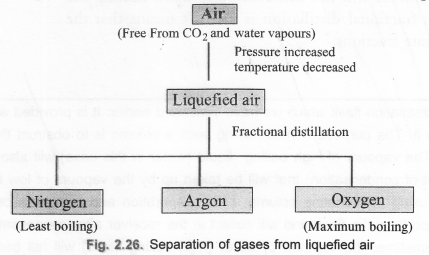
(b) Nitrogen (N2) condenses first because its boiling point is the least (-196°C) among all the gases present in air.
Question 42.
Name the appropriate methods for the separation of the following :
- nitrogen from air
- dye from blue ink
- cream from milk
- ammonium chloride from common salt.
Answer:
- Nitrogen is one of the constituents of air. It can be separated with the help of fractional distillation,
- Chromatography helps in separating dye from blue ink.
- Centrifugation or churning helps in separating cream from milk.
- Ammonium chloride is of volatile nature while common salt (sodium chloride) is not. The separation can be done with the help of sublimation.
Question 43.
(a) Identify the solute and solvent in tincture of iodine.
(b) Why is Tyndall effect not seen in a true solution ?
Answer:
(a) In tincture of iodine; solute present is iodine and solvent is ethyl alcohol.
(b) In a true solution, the particle size is so small that it does not scatter the beam of light. Therefore,
Tyndall effect is not seen in a true solution.
Question 44.
- Arrange solids, liquids and gases in increasing order of the following properties of matter
- rigidity
- diffusion
- compressibility.
- Write one example from your daily life which is based on diffusion of gases.
Answer:
- Rigidity : Gases < Liquids < Solids
- Diffusion : Solids < liquids < gases
- Compressibility : Gases < Liquids < Solids
- Smell of aroma or perfume released in one corner of the room soon spreads throughout.
Question 45.
What is a saturated solution ? What happens when a saturated solution is heated ?
Answer:
A solution is said to be saturated if no more of a solute can dissolve in it at a given temperature.
A saturated solution becomes unsaturated upon heating.
Question 46.
- Colloidal solutions show Tyndall effect but true solutions do not. Discuss.
- Explain how does soap help in cleaning dirty clothes ?
Answer:
- In a colloidal solution, the particle size is such (1 nm to 100 nm), that these particles scatter the light rays as they fall on them. Because of scattering, the path of the light as well as the particles become visible. But in a true solution, the particle size is so small (less than 1 nm) that these particles are not in a position to scatter the light. Therefore, true solution does not show any Tyndall effect.
- In dirty clothes, the dust particles are sticking on the oil drops present. Simple water cannot remove these oil drops from the clothes because water and oil as such do not form a stable emulsion. Soap plays the role of emulsifier and helps in forming a stable emulsion between the two. In other words, it helps in mixing oil and water. This means that soap helps in removing these oil drops along with the dirt sticking to them. The dirty clothes get washed by soap solution.
Class 9 Science Chapter 2 Long Answer Questions
Question 47.
- Fog and cloud are both colloidal in nature. How do they differ ?
- What is the function of fractionating column in fractional distillation ?
Answer:
- Both fog and cloud are the examples in which liquid (water) is the dispersed phase and gas (air) is the dispersion medium. The only difference between them is that clouds are formed in the upper atmosphere while fog gets formed in the region close to earth.
- A fractionating column obstructs the upwards movement of the vapours of the liquids. As a result, the energy (latent heat of condensation) which is released by the high boiling liquid is taken by the low boiling liquid. It remains in the vapour state. The high boiling liquid by releasing energy condenses and falls back in the distillation flask. Thus, fractionating column helps in the separation of the components from a liquid mixture. For example, a mixture of ethyl alcohol and water.
Question 48.
- Can we separate a mixture of water and alcohol by the use of a separating funnel ? If not, suggest a suitable method.
- You are provided with two liquids, one is a mixture of two miscible liquids while the other is a pure compound. Suggest two ways to distinguish them from each other.
Answer:
- No, it is not possible because water and alcohol form a miscible liquid mixture. The separation can be done with the help of fractional distillation. Alcohol (ethyl alcohol) with lesser boiling point distills leaving behind water in the distillation flask.
- The distinction can be made as follows :
- In case the constituents of a given liquid can be separated by methods like simple distillation or fractional distillation, it is a liquid mixture. If it is not possible, then the liquid is a compound.
- Find the boiling points of both the liquids. In case it is sharp, the given liquid is a compound. In case it is not, then the given liquid is a mixture.
Question 49.
Classify the following as physical and chemical changes. Give reason for your answer.
- Burning of candle.
- Melting of ice.
- Burning of petrol in an engine.
- Change of colour of iron bar on strong heating.
- Churning of milk to get butter.
Answer:
- Chemical change : The way present in the candle changes to liquid state. This means that the change is of physical nature. At the same time, the constituents carbon and hydrogen present in wax react with oxygen of air to form new substances. This means that a chemical reaction or change is also taking place.
- Physical change : When water formed as a result of melting of ice is cooled to 0°C, it changes back to ice.
- Chemical change : Petrol is a mixture of different hydrocarbons. They undergo oxidation or combustion upon burning to form carbon dioxide and water vapours along with heat energy. Therefore, it is a chemical change.
- Physical change : Iron bar regains its colour on cooling.
- Physical change : There is only a change of physical state and no new substance is formed.
Question 50.
Give an example of a mixture which exhibits the following characteristics.
- Two non-miscible components.
- Two volatile components differing in boiling points by more than 30°C.
- Two coloured components.
- Water containing a soluble salt.
- Volatile and non-volatile solid components.
Suggest a suitable method for separating constituents in each case.
Answer:
- Carbon disulphide and water. The separation can be done by a separating funnel.
- Ethyl alcohol and ether. The separation can be done by simple distillation. However, proper precaution must be taken since ether vapours catch fire.
- A mixture of blue-black ink. Separation can be done by chromatography.
- A mixture of copper sulphate and water. The separation can be done by concentration followed by cooling the concentrated solution (crystallisation).
- A mixture of naphthalene and sodium chloride. Separation can be done in a china dish, covered by a funnel. The process is called sublimation. Naphthalene gets separated as sublimate leaving behind sodium chloride.
Question 51.
You are provided with a mixture containing iron filings, ammonium chloride, sand and sodium chloride. Describe the procedure that you would use to separate the constituents from the mixture.
Answer:
Place the mixture on a paper or petridish. Move a bar magnet a number of times over the mixture. Iron filings get attached to the magnet and can be separated later on by scrapping. Transfer the remaining mixture to a china dish and subject it to the sublimation process. Ammonium chloride sublimes leaving behind sodium chloride and sand. Transfer the mixture to a glass beaker. Add a small amount of water and stir with a glass rod for some time. Sodium chloride completely dissolves in water leaving behind sand as such. The latter can be removed by filtration. The filtrate on concentration and cooling gives crystals of sodium chloride.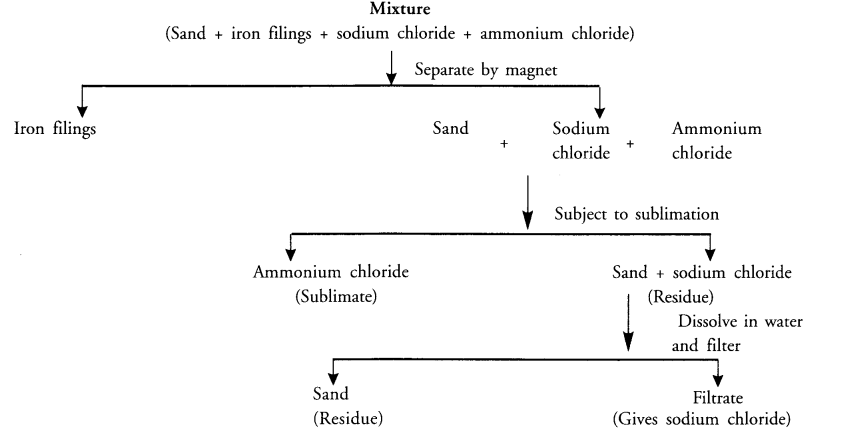
Question 52.
Process of simple distillation can be used to separate the constituents from a liquid mixture differing in their boiling points by 25°C or more. However, fractional distillation is effective if the difference in boiling points is less than 25°C. How will you explain this ?
Answer:
In simple distillation, only the low boiling liquid will distil while high boiling liquid will remain in the distillation flask. Thus, separation can be done if the difference in the boiling points of the liquids is 25° C or more. In the second case, both the liquids will distil simultaneously. The distillate will contain the fractions of both the liquids. If a fractionating column is used, the vapours of high boiling liquid will also rise into the column along with the low boiling liquid. But they will condense first releasing energy (called latent heat of condensation) and fall back in the distillation flask as a liquid. This energy will be absorbed by the vapours of the low boiling liquid which will remain in the vapour state. It will get distilled while the high boiling liquid unable to get distilled, will remain in the distillation flask only. In this way, separation can be done. Thus, the role of fractionating column is to put obstructions in the path of the vapours of the liquids that are rising upwards.
Question 53.
Give an example of a mixture which exhibits following characteristics.
- Two non-miscible components,
- Two volatile components with appreciable difference in boiling points.
- Two coloured components.
- Water containing certain suspended particles.
- Water containing a soluble salt. (f) A volatile and a non-volatile component.
Answer:
- A mixture of kerosene and water.
- A mixture of ether (b.p. = 35° C), and ethyl alcohol (b.p. = 78° C).
- A mixture of blue/black ink.
- A colloidal solution of starch.
- A mixture of copper sulphate in water.
- A mixture of ammonium chloride and sodium chloride.
Question 54.
Rama tested the solubility of four substances at different temperatures and found in grams of each substance dissolved in 100 g of water to form a saturated solution.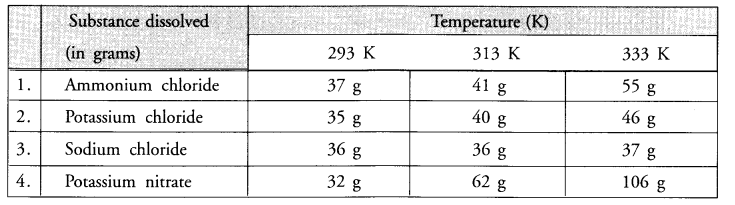
- Which substance is least soluble at 293 K.
- Which substance shows maximum change in its solubility when the temperature is raised from 293 K to 313 K ?
- Find the amount of ammonium chloride that will separate out when 55 g of its solution at 333 K is cooled to 293 K.
- What is the effect of temperature on the solubility of a salt ? –
- What mass of sodium chloride would be needed to make a saturated solution in 10 g of water at 293 K ?
Answer:
- Potassium nitrate is least soluble in water at 293 K.
- Potassium nitrate shows maximum change in its solubility which is 30 g (62-32) per 100 g of water.
- From the available information, 55 g of ammonium chloride solution upon cooling from 333 K to 293 K separates salt = (55 – 37) = 18 g.
- From the available information, it is clear that the solubility of salt in water increases with the rise in temperature.
- At 293 K, in a saturated solution,
100 g of water has sodium chloride = 36 g
10 g of water has sodium chloride = 3.6 g
Question 55.
- Name the separation technique used to separate the constituents of the mixture of miscible liquids. Draw a labelled diagram of the process for separating mixture of acetone and water.
- List two properties of the mixture of miscible liquids essential for the process.
- K simple fractionating column is provided with beads. Give reasons.
Answer:
- The separation technique depends upon the boiling temperature difference between the miscible liquids.
If they differ in their boiling points by 25°C or more, the separation can be done by simple distillation. If the difference is less than 25°C, fractional distillation is used. Acetone (b.p. = 56°C) and water (b.p. = 100°C) can be separated by simple distillation. For the labelled diagram,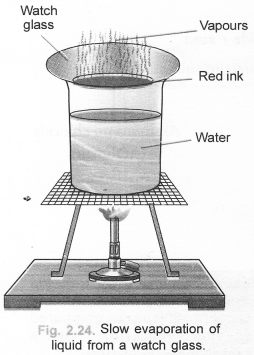
- The constituents of the miscible liquids should be volatile in nature.
The constituents of the miscible liquids should not react chemically with each other. - The purpose of beads in the fractionating column is to obstruct the upward movement of liquid with higher boiling point. This helps in the separation of the two liquids.
Question 56.
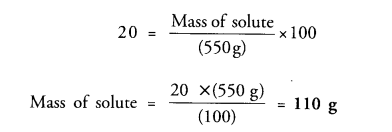
The concentration of a salt solution in terms of mass by mass percentage is 20% and the mass of the solution is 550 g. Determine the mass of solute present in the solution.
Answer:
Question 57.
(a) To make a saturated solution, 36 g of sodium chloride is dissolved in 100 g of water at 293 K. Find the concentration at this temperature.
(b) What is the effect of temperature on the solubility of a solid in a liquid ?
(c) Why is it possible to distinguish the particles of a solute from those of a solvent in a suspension ?
Answer: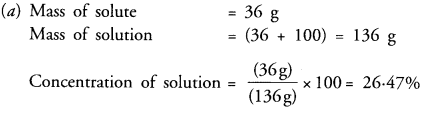
(b) Solubility of a solid in a liquid is generally directly proportional to the temperature. If the temperature increases, the solubility increases. If the temperature decreases, so is the solubility. However, there are some exceptions also. Solubility of lithium carbonate in water decreases with increase in temperature.
(c) In a suspension, the size of the particles of the dispersed phase is quite big. They can be easily distin¬guished from the particles of the dispersion medium. They can be seen even with naked eye.