Question 1.
Why do we classify organisms ? (CCE 2012)
Answer:
- Identification is not possible without any system of classification.
- Classification helps in bringing out similarities and dissimilarities amongst organisms.
- Relationships are built up with the help of classification. They indicate the evolutionary pathways.
- Organisms of other localities and fossils can be studied only with the help of a system of classification.
- It is not possible to study every organism. Study of one or two organisms gives sufficient idea about other members of the group.
- Other branches of biology depend upon proper identification of the organism which is possible only through a system of classification.
Question 2.
Give three examples of the range of variations that you see in life forms around you.
Answer:
- Size: It varies from microscopic organisms (e.g., bacteria, size 0-5-5-0 pm) to very large sized animals (e.g, Blue whale, 30 metres long) and trees (e.g, Redwood tree, height 100 metres).
- Life Span: May fly lives for one day, most mosquitoes for a few days while some Pine trees live for thousands of years.
- Colour: Jelly fish and many worms are colourless. Birds, butterflies and flowers are variously coloured brightly.
Question 3.
Which do you think is a more basic characteristic for classifying organisms ?
(a) The place they live
(b) The kind of cells they are made of Why ? (CCE 2012)
Answer:
The kind of cells: Habitat is a place where diverse types of organisms live together. It cannot be used for classifying organisms. Cells have specific structure, prokaryotic in monerans and eukaryotic in the remaining organisms.
Organisms are unicellular in protista and multicellular in others. A cell wall is absent in animals. Cell wall contains chitin in fungi and cellulose in plants. Plastids occur in plant cells. They are absent in animal cells.
Question 4.
What is the primary characteristic on which the first division of organisms is made ? (CCE 2012)
Answer:
Type of cell, prokaryotic (genetic material or nucleoid free in cytoplasm) and eukaryotic (genetic material enclosed in nucleus).
Question 5.
On what basis are plants and animals put into different categories ? (CCE 2012)
Answer:
Plants and animals are placed in different categories because they differ in several characteristics.
- Shape: Animals have a definite shape while plants have less definite shape.
- Branching: Animals are unbranched (exception sponges), while plants are generally branched.
- Growth: Animals stop growing after reaching a certain size. Plants continue to grow till death.
- Locomotion: Animals can move from place to place (exception corals, sponges) while plants are fixed.
- Nutrition: Animals eat ready made food while plants manufacture their own food.
- Reserve Food: It is glycogen in animals and starch in plants.
- Cell Wall: Animal cells do not have a covering of wall while individual plant cells are surrounded by cell walls.
- Excretory Organs: They are present in animals but absent in plants.
- Sense Organs and Nervous System: They are found in animals but not in plants.
Question 6.
Which organisms are called primitive and how are they different from the so called advanced organisms ?
(CCE 2011, 2012)
Answer:
Primitive organisms are those organisms which have simple ancient body design with only basic characteristics of the group. There has been little change over a long period of time. Specialisations are fewer.
Advanced organisms are more recent organisms. They are also called higher organisms because they possess several specialisations. They have more complex structure and some new characteristics alongwith the basic ones.
Question 7.
Will advanced organisms be the same as complex organisms ? Why ? (CCE 2012, 2015)
Answer:
Yes. Advancement is based on development of specializations. Specialisation occurs where there is more elaboration and hence more complexity. However, there is likelihood of specialisation to lead to overspecialisation which becomes a hindrance to competitive nature of existence in the biosphere. Dinosaurs, giant crocodiles and mammoth have died down due to this reason. Therefore, advancement is possible only if specialisation leads to greater elaboration and efficiency.
Question 8.
What is the criterion for classification of organisms as belonging to kingdom Monera or Protista ?
(CCE 2012, 2014)
Answer:
Cell structure is used as a criterion for placing an organism in monera or protista. In monera the cells are prokaryotic. Membrane bound cell organelles are absent. In protista the cells are eukaryotic.
Membrane bound cell organelles are present. Protista contains only unicellular eukaryotes. Monera may have unicellular or multicellular forms.
Question 9.
In which kingdom will you place an organism which is single-belled, eukaryotic and photosynthetic ?
(CCE 2012, 2013)
Answer:
Protista.
Question 10.
In the hierarchy of classification, which grouping will have the smallest number of organisms with a maximum of characteristics in common and which will have the largest number of organisms.
(CCE 2011, 2012)
Answer:
- Small number (one) with maximum common characteristics— Species
- Largest number— Kingdom.
Question 11.
Which division among plants has the simplest organisms ?
Answer:
Thallophyta.
Question 12.
How are pteridophytes different from phanerogams ? (CCE 2012)
Answer:
| Pteridophytes | Phanerogams/Spermatophytes |
| 1. Nature. They are seedless plants. | Phanerogams are seed bearing plants. |
| 2. Gametophyte. Gametophytes are small but independent. | Gametophytes are nutritionally dependent upon the sporophyte. |
| 3. Reproductive Organs. They are inconspicuous. | Reproductive organs are quite conspicuous. |
| 4. External Water. An external water is required for fertilization. Examples. Ferns, Lycopodium. | Fertilization does not require an external water. Examples. Pinus, Maize. |
Question 13.
How do gymnosperms and angiosperms differ from each other ? (CCE 2012)
Answer:
| Gymnosperms | Angiosperms |
| 1. Sporophylls. They are aggregated to form cones. | Sporophylls are aggregated to form flowers. |
| 2. Seeds. The seeds are naked. | The seeds are enclosed by fruit wall. |
| 3. Microspores and Megaspores. The micro-spores and megaspores are produced by male and female cones. | They are produced in the same or two different types of flowers. |
| 4. Vascular Tissues. Xylem lacks vessels and phloem lacks companion cells. | Xylem contains vessels and phloem contains companion cells. |
| 5. Ovules. The ovules are not contained in the ovary. | The ovules are enclosed in the ovary. |
| 6. Endosperm. It is haploid. | It is triploid. |
Question 14.
How do poriferan animals differ from coelenterate animals ?
Answer:
| Poriferans | Coelenterates |
| 1. Organisation. It is of cellular level. | It is of tissue level. |
| 2. Pores. A number of inhalent pores or ostia and a single exhalent pore or osculum are present. | There is a single opening. |
| 3. Digestion. It is intracellular. | It is both intracellular and intercellular. |
| 4. Muscle and Nerve Cells. They are absent. | Primitive muscle and nerve cells appear for the first time in coelenterates. |
| 5. Appendages. They are absent. | Appendages are represented by tentacles. |
| 6. Special Cells. The special cells are choanocytes or collar cells. | Special cells are cnidoblasts. |
Question 15.
How do annelid animals differ from arthropods ? (CCE 2012)
Answer:
| Annelids | Arthropods |
| 1. Appendages. They are unjointed. 2. Circulation. Blood flows inside blood vessels (closed circulatory system). 3. Coelom. True coelom is well-developed. 4. Chitinous Exoskeleton. A chitinous exoskeleton is absent. 5. Excretory Organs. 6. Sensory System. It is less developed. 7. Locomatory Organs. They are parapodia and setae. | Appendages are jointed. Blood flows through large fused sinuses or spaces (open circulatory system). True coelom is small. Instead, blood filled false body cavity called haemocoel is present. A chitinous exoskeleton is present. Excretory organs are green glands and malpighian tubules. Sensory system is well-developed. They are legs and wings. |
Question 16.
What are the differences between amphibians and Pisces? (CCE 2012)
Answer:
| Pisces | Amphibians |
| 1. Scales. The body is covered by scales. | 1. Scales are absent. |
| 2. Mucous Glands. The skin does not possess mucous glands. | 2. The skin has mucous glands that keep the skin moist and slippery. |
| 3. Fins. Pisces possess fins for locomotion and steering | 3. Fins may occur in larval stage. The adult does not possess fins. Limbs occur instead. |
| 4. Heart. It is two chambered. | 4. Heart is 3-chambered. |
| 3. Lungs. Pisces do not have lungs. | 5. Lungs are present. |
| Examples. Scoliodon, Labeo. | Examples. Frog, Toad. |
Question 17.
What are the differences between animals belonging to the aves group and those in mammalia group ? (CCE 2012)
Answer:
| Aves | Mammalia |
| 1. Wings. Forelimbs are modified into wings. | Wings are absent except in bats. |
| 2. Feathers and Scales. The body is covered with feathers and scales. | Feathers and scales are absent. |
| 3. Skin Glands. Skin is dry. Only a single preen gland is present. | Skin bears a number of sweat and oil glands. |
| 4. Mammary Glands. They are absent. | Female possesses mammary glands for feeding the young |
| 5. Diaphragm. A diaphragm is absent. | A partition called diaphragm is present between abdomen and thorax. |
| 6. Beak. A toothless beak is present. | Jaws do not form a beak. Teeth are present. |
| 7. Bones. They are hollow or pneumatic. | Bones do not possess air cavities. |
| 8. Larynx/Syrinx. Larynx is non-functional. Instead syrinx is present. | Larynx is functional. Syrinx is absent. |
| External air sacs do not occur over lungs. | |
| 9. Air Sacs. Lungs possess external air sacs. | |
| 10. Yolk. Eggs possess a lot of yolk (macrolecithal). | Eggs have little yolk (alecithal). |
| 11. Reproduction. Birds are oviparous. | Mammals are viviparous with the exception of a few species. |
NCERT CHAPTER END EXERCISES
Question 1.
What are the advantages of classifying organisms ? (CCE 2012, 2013, 2014)
Answer:
- Identification is not possible without any system of classification.
- Classification helps in bringing out similarities and dissimilarities amongst organisms.
- Relationships are built up with the help of classification. They indicate the evolutionary pathways.
- Organisms of other localities and fossils can be studied only with the help of a system of classification.
- It is not possible to study every organism. Study of one or two organisms gives sufficient idea about other members of the group.
- Other branches of biology depend upon proper identification of the organism which is possible only through a system of classification.
Question 2.
How would you choose between two characteristics to be used for developing a hierarchy in classification ?
Answer:
The character which is of fundamental importance, generally present in larger number of organisms, as a change in body design, is used in raising a higher category. The character of lesser importance, generally present in smaller number of individuals is used for raising lower category.
Question 3.
Explain the basis for grouping of organisms into five kingdoms. (CCE 2012, 2013)
Answer:
Four criteria have been used for grouping of organisms into five kingdoms—
- Procaryotic and eukaryotic nature
- Unicellular and multicellular nature
- Nutrition
Question 4.
How are criteria for deciding divisions in plants different from the criteria for deciding subgroups amongst animals ?
Answer:
Body design of plants is quite different from that of animals. Plants are anchored. They require organs for fixation and absorption. Plants are autotrophic. Reproductive organs, mechanical tissues and conducting tissues have evolved in higher plants. In animals the requirement is mobility for obtaining food and other necessities. Their evolution has occurred towards greater mobility, protection, increased efficiency in obtaining food and care of young ones. Therefore, criteria for deciding divisions or subgroups are different for plants and animals.
Question 5.
What are the major divisions in the plantae ? What is the basis for these divisions ? ( CCE 2015)
Answer:
- Multicellularity. Plantae includes multicellular organisms except for some primitive relatives of algae.
- They are eukaryotes, that is, with a nucleus and membrane bound cell organelles.
- Cell Wall. A cell wall generally containing cellulose occurs around cells.
- Central Vacuole. A mature cell commonly possesses a single large central vacuole.
- Food Reserve. It is starch and fat.
- They are double membrane covered cell organelles found in all plants. Some plastids possess photosynthesis pigments. They are called chloroplasts.
Kingdom plantae has three levels of classification:
- The first level of classification deals with presence or absence of well differentiated distinct parts. Undifferentiated plants are included amongst thallophyta.
- The second level of classification deals with presence or absence of vascular tissues.
- The third level of classification is based on the presence or absence of seeds and whether the seeds are exposed or enclosed inside fruits.
Question 6.
Explain how animals in vertebrata are classified into further subgroups.
Answer:
Vertebrata is divided into five classes—pisces, amphibia, reptilia, aves and mammalia on the basis of following characteristics :
- It consists of scales in fishes and reptiles, feathers in birds and hair in mammals. Skin is smooth and moist in amphibians.
- It is cartilaginous in chondrichthyes and bony in others.
- It occurs through gills in all fishes and larvae of amphibians. Other have lungs for breathing.
- Fishes and amphibians lay eggs in water. Reptiles and birds do so outside water.
- They occur in birds. Wings are used for flight.
- External Ears. They occur in mammals.
- Mammals generally show vivipary or give birth to young ones.
PRACTICAL BASED TWO MARKS QUESTIONS
Question 1.
The body of an organism is stream lined and is found in fresh water as well marine water. Identify the organism and write its one specific feature ? (CCE 2015)
Answer:
Fish, presence of fins, gills and scales.
Question 2.
Name the habitat of earthworms and how is it useful to them. (CCE 2015)
Answer:
Moist soil where they can obtain decaying organic matter as well as dig burrows easily.
Question 3.
Draw the diagram of a bony fish and write one of its adaptive feature. (CCE 2015)
Answer: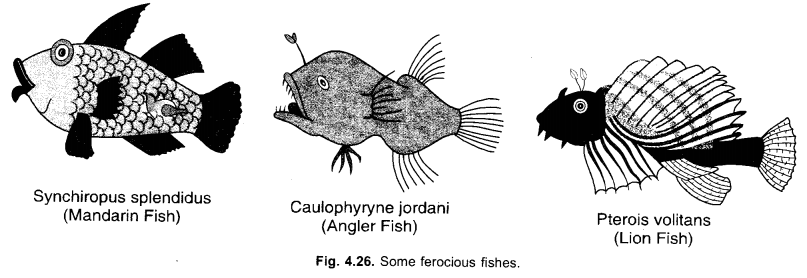
Adaptive feature : Presence of air bladder for remaining afloat inside water without spending energy.
Question 4.
After observing an earthworm carefully. Samir decided to place it in phylum Annelida. Which two features did he observe that helped him to do so ? (CCE 2015)
Answer:
- Elongated, cylindrical and segmented body,
- Presence of closed circulatory system with red-blood.
Question 5.
Mention two features adopted by birds which help them to fly.
(CCE 2015)
Answer:
- Fore limbs modified into wings,
- Stream-lined body with pneumatic bones.
Question 6.
Amita was shown the posterior parts of two cockroaches (I and II)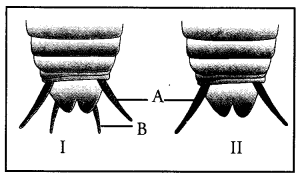
(a) She was asked to identify parts A and B.
(b) Which one of them is a male cockroach ?
(c) On which segment is part B present.
Write the correct answers. (CCE 2015)
Answer:
(a) A – anal cercus,
B – anal style.
(b) I is male cockroach
(c) Ninth segment.
Question 7.
Identify X and Y in the diagram of the part of earthworm drawn here. What function is performed by X ? (CCE 2015)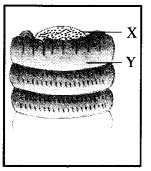
Answer:
X: Prostomium.
Y: Peristomium.
Functions of X:
- Sensory structure for receiving information about the environment.
- Pushing moist earth during digging of furrow.
Question 8.
What are the functions of modified hindlimbs of birds ? (CCE 2015)
Answer:
- Perching
- Walking
- Wading in aquatic birds.
Question 9.
Complete the following table (CCE 2016)
Answer:
1. Cockroach, chitinous exoskeleton (Arthropoda).
2. Earthworm, hydraulic skeleton (Annelida).
Question 10.
Give two identifying features of the phylum to which earthworm belongs. (CCE 2016)
Answer:
Annelida:
- Metameric segmentation
- Closed circulatory system.
Question 11.
State any two ways by which earthworm’s body is adapted to live in soil. (CCE 2016)
Answer:
- Elongated cylindrical body with moist skin
- Setae for firm grip
- Coelomic fluid developing hydraulic power for digging. /
Question 12.
(a) How are birds modified to reduce body weight for flying ? .
(b) Which part of the body is modified for flight ? (CCE 2016)
Answer:
(a) Hollow bones
(b) Fore limbs modified into wings.
Question 13.
Name any two characteristic features of class Reptilia. (CCE 2016)
Answer:
- Dry, nonglandular rough skin having scales
- Incompletely four-chambered heart.
Question 14.
The teacher had shown a student a specimen R and asked him it is a female Pinus cone. What feature will the student look for the identification of the specimen ? (CCE 2017)
Answer:
- Occurrence of megasporophylls and bract scales
- Presence of ovules or seeds (two) on the adaxial side of each magasporophyll (ovuliferous scale).
SELECTION TYPE QUESTIONS
Alternate Response Type Questions
(True/False. Right/Wrong-, Yes/No)
Question 1.
Prokaryotes do not have a true nucleus but possess all other types of organelles.
Question 2.
Paramecium possesses two types of nuclei, micronucleus and macronucleus.
Question 3.
Lichen is formed by symboitic association between an alga and a fungus.
Question 4.
Platypus and Echidna are reptiles that give birth to live young ones.
Question 5.
The largest bird is Ostrich.
Question 6.
Chameleon is an amphibian.
Question 7.
Angiosperms are also called flowering plants.
Question 8.
Algae are amphibians of plant kingdom.
Matching Type Questions :
Question 9.
Match the articles of the column I and II (single matching)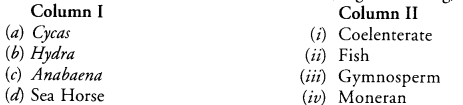
Question 10.
Match the contents of columns I, II and III (Double matching)
Question 11.
Which type of nutrition- autotrophic (A), decomposer (D), and holozoic (H) occurs in the organisms listed below (key or checklist items).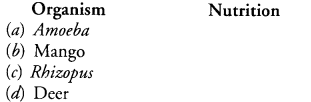
Question 12.
Match the Stimulus with Appropriate Response.
Fill In the Blanks
Question 13. Bird wings are modified ………….. limbs.
Question 14. …………… is a phylum of spiny skinned sea animals.
Question 15. Roundworm has ……………. symmetry.
Question 16. Gymnosperms have ……………. seeds.
Question 17. Fungi are …………….. organisms.
Answers:
SOME ACTIVITY BASED QUESTIONS
Question 1.
Give one point of difference between Gymnosperms and Angiosperms. (CCE 2012, 2014)
Answer:
Seeds are naked or exposed in gymnosperms but seeds are covered by fruit wall or pericarp in angiosperms.
Question 2.
Define phytogeny.
Answer:
The evolutionary history of organisms is termed as phylogeny.
Question 3.
Identify the animal group having :
- Body spiny and radial symmetry
- Bones light and hollow
- 4 pairs of jointed legs and no wings.
- Soft bodied animals supported by calcareous shells.
- External ear or pinna.
Answer:
- Echinodermata
- Aves
- Arachnida
- Mollusca
- Mammalia.
Question 4.
Give one point of difference between notochord and nerve cord.
Answer:
Notochord is an ensheathed flexible rod of turgid cells located along the back of chordate embryos and some prinitive adult chordates ventral to the nerve cord. It provides attachment to muscles. Notochord has given rise to jointed axial skeleton of cranium and vertebral column. Nerve cord is a collection of nerve fibres that runs throughout the length of an animal. It is hollow and dorsal in chordates where it gets modified into central nervous system of brain and spinal cord. Nerve cord is solid and ventral in nonchordates.
Question 5.
What is haemocoel ? Which groups of animals have haemocoel ?
Answer:
The blood filled cavity consisting of spaces in between the organs is known as haemocoel. Examples— Arthropoda and Mollusca.
Question 6.
Give one example of hemichordata, urochordata and cephalochordata.
Answer:
- Hemichordata- Balanoglossus.
- Urochordata— Herdmania.
- Cephalochordata- Amphioxus.
Question 7.
Differentiate the nature of skin in four classes of tetrapoda.
Answer:
The nature of skin in four classes of tetrapoda are—
- Class Amphibia- Thin, moist, glandular and respiratory skin.
- Class Reptilia— Dry and non-glandular skin with scales.
- Class Aves- Dry and non-glandular skin with feathers.
- Class Mammalia— Glandular skin with hairs.
Question 8.
Why whales are not grouped in the fishes ? (CCE 2012)
Answer:
Whales can swim in water like the fishes but are not fish as they respire with lungs, have four chambered heart, diaphragm and mammary glands. So they are mammals.
Question 9.
List a few flight/aerial adaptations in birds.
Answer:
- Forelimbs are modified into wings.
- Body is covered with exoskeleton of feathers.
- Long bones are pneumatic having air cavities.
- Body is stream-lined to reduce air resistance.
- Well developed flight muscles.
- Presence of air sacs to help in double respiration.
- Tail feathers form a steering apparatus.
- They have acute vision.
Question 10.
Give one example of each :
- Asymmetry, radial and bilateral symmetry
- Acoelomates, pseudocoelomate and haemocoelomate.
Answer:
- Amoeba, Hydra and a fish.
- Flatworms, Roundwarms and Arthropods.
Question 11.
In what way, amphibians are advanced than the fishes ?
Answer:
Amphibians have three-chambered heart and lungs for respiration, while fishes have two-chambered heart and gills for respiration.
Question 12.
Why is Euglena called dual organism! plant-animal ? (CCE 2012)
Answer:
Euglena is called plant-animal because it has characteristics of both plants and animals. Like plants, Euglena has chloroplasts with the help of which it performs photosynthesis. Like animals, it lacks cell wall, possesses pellicle, an anterior invagination, flagellum, eye spot, etc. and capable of obtaining ready made food in dark.
Question 13.
Why are protozoa called early animals ?
Answer:
Protozoa (pro-ancient, zoo—animal) are called early animals because like animals they have holozoic nutrition and glycogen as food reserve. They have, however, unicellular nature and are without an embryo stage. Protozoa evolved before the evolution of true animals or metazoa.
Question 14.
Name the organisms which has
- Setae and Parapodia
- Tube feet
Answer:
- Nereis
- Starfish